Alireza S. Ziabari, Nona Ghazizadeh, Zhivar Sourati, Farzan Karimi-Malekabadi, Payam Piray, Morteza Dehghani (2026). Proceedings of the Conference on Language Modeling (COLM)
Research
Machine Cognition & Alignment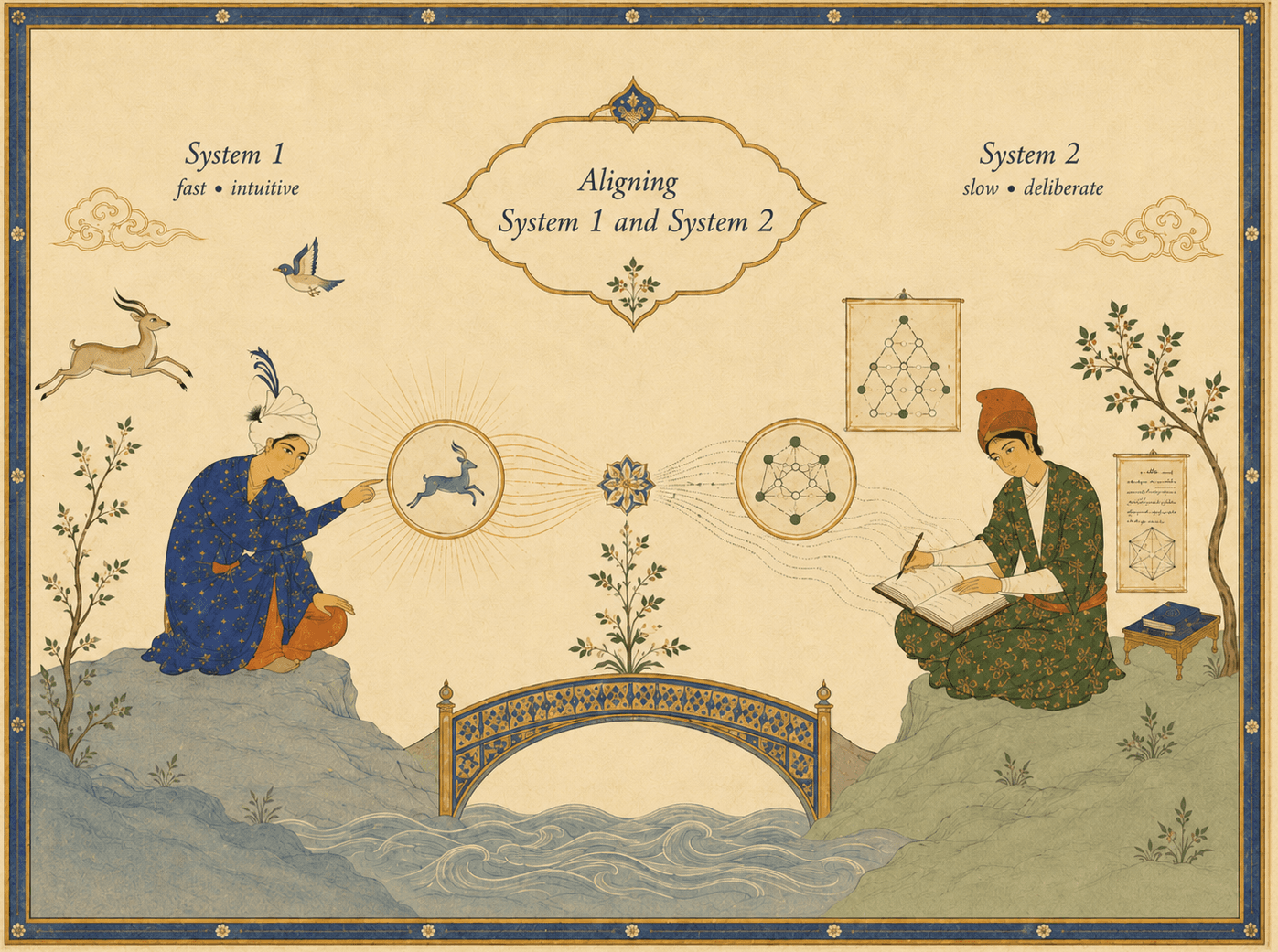
We bridge psychological theories of human cognition with AI architecture to build more robust, human-centric systems. Our research focuses on aligning large language models to human-like reasoning styles, such as System 1 and System 2 thinking, and adapting models to heterogeneous individual preferences. Furthermore, we explore the broader capabilities of artificial systems by designing cognitively plausible frameworks for schema-based learning, structural abstraction, analogical reasoning, continuous memory adaptation, and autonomous agent coordination through learned representations.
KEY PUBLICATIONS
Zhivar Sourati, Farzan Karimi-Malekabadi, Meltem Ozcan, Colin McDaniel, Alireza Ziabari, Jackson Trager, Ala Tak, Meng Chen, Fred Morstatter, Morteza Dehghani (2026). Nature Human Behaviour
Elnaz Rahmati, Nona Ghazizadeh, Zhivar Sourati, Nina Rouhani, Morteza Dehghani (2026). arXiv preprint (arXiv:2603.17198)
Pluralistic AI
We develop multi-perspective models that capture subjective, community-specific viewpoints, ensuring intelligent systems reflect diverse human experiences rather than a single normative standard. Our project on police body-worn camera footage models the inherent subjectivity of respect, translating complex law enforcement interactions into objective metrics for policy evaluation and training. By capturing nuanced communication signals, this line of work focuses on designing frameworks to recognize the diverse ways different communities perceive social interactions.
KEY PUBLICATIONS
Preni Golazizian, Elnaz Rahmati, Jackson Trager, Zhivar Sourati, Nona Ghazizadeh, Georgios Chochlakis, Jose Alcocer, Kerby Bennett, Aarya Vijay Devnani, Parsa Hejabi, Harry G. Muttram, Akshay Kiran Padte, Mehrshad Saadatinia, Chenhao Wu, Alireza S. Ziabari, Michael Sierra-Arévalo, Nick Weller, Shrikanth Narayanan, Benjamin A. T. Graham, Morteza Dehghani (2026). Proceedings of the 64th Annual Meeting of the Association for Computational Linguistics (Volume 1: Long Papers)
Aida Mostafazadeh Davani, Mohammad Atari, Brendan Kennedy, Morteza Dehghani (2023). Transactions of the Association for Computational Linguistics, 11:300–319
Ali Omrani, Alireza Salkhordeh Ziabari, Charles Yu, Preni Golazizian, Brendan Kennedy, Mohammad Atari, Heng Ji, Morteza Dehghani (2023). Proceedings of the 61st Annual Meeting of the Association for Computational Linguistics (ACL 2023), Volume 1: Long Papers, pages 4123–4139
Language, Morality, and Intergroup Dynamics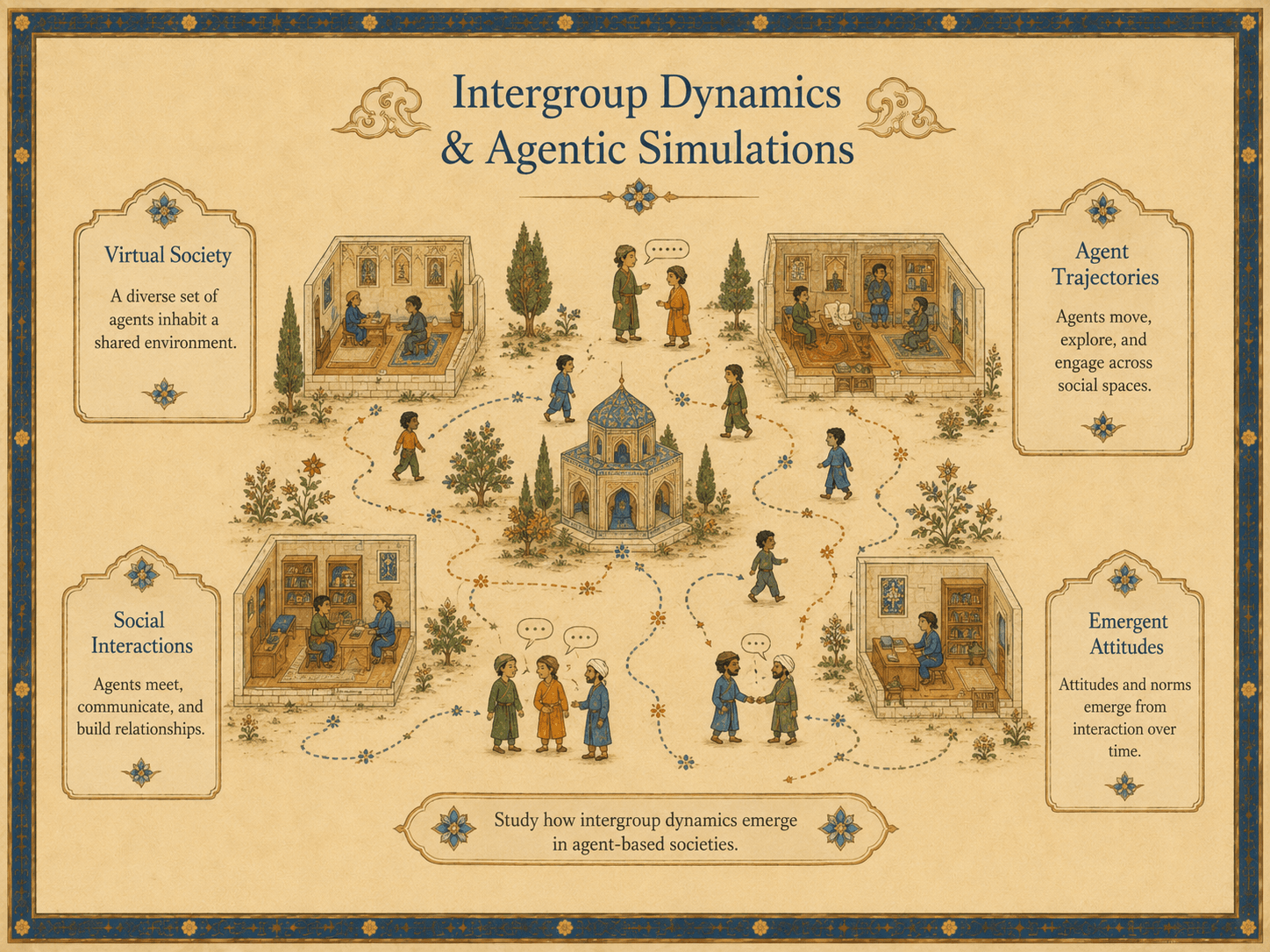
We investigate how moral values, social biases, and threat perceptions are expressed in language, spread through social networks, and embedded within intelligent systems. This work leverages computational methods and natural language processing to understand the psychological antecedents of prejudice and the dynamics of intergroup conflict. By bridging the evaluation of large language models with generative-agent simulations, our recent work traces the internal organization of moral foundations and provides causal, dynamic accounts of how perceived threats shape social behavior over time.
KEY PUBLICATIONS
Marlon Mooijman, Joe Hoover, Ying Lin, Heng Ji, Morteza Dehghani (2018). Nature Human Behaviour, 2(6), 389–396
Joe Hoover, Mohammad Atari, Aida Mostafazadeh Davani, Brendan Kennedy, Gwenyth Portillo-Wightman, Leigh Yeh, Morteza Dehghani (2021). Nature Communications, 12, 4585
Suhaib Abdurahman, Farzan Karimi-Malekabadi, Chenxiao Yu, Nour S. Kteily, Morteza Dehghani (2025). arXiv preprint (arXiv:2512.17066)
Chenxiao Yu, Bowen Yi, Farzan Karimi-Malekabadi, Suhaib Abdurahman, Jinyi Ye, Shrikanth Narayanan, Yue Zhao, Morteza Dehghani (2026). arXiv preprint (arXiv:2601.05437)